About Us / Resources / Articles
The MAPA Integrative Neuro-Linguistic Therapeutic Practice
About Us / Resources / Articles


Mr Francis PETOT
"Hypnosis Master, WHO" training by trainer Mr Francis PETOT in Luxembourg
Read moreFrom Technique to Accountable Therapeutic Practice
The MAPA Integrative Neuro-Linguistic Therapeutic Practice
A Critical Review and Framework for Responsible NLP-Based Practice
André Percia
Clinical Psychologist; NLP Master Trainer, IN; Trainer in Hypnosis and Coaching
Summary
This article outlines the official standards and curriculum for two advanced qualifications in Integrative Neuro-Linguistic Therapeutic Practice developed by André Percia.
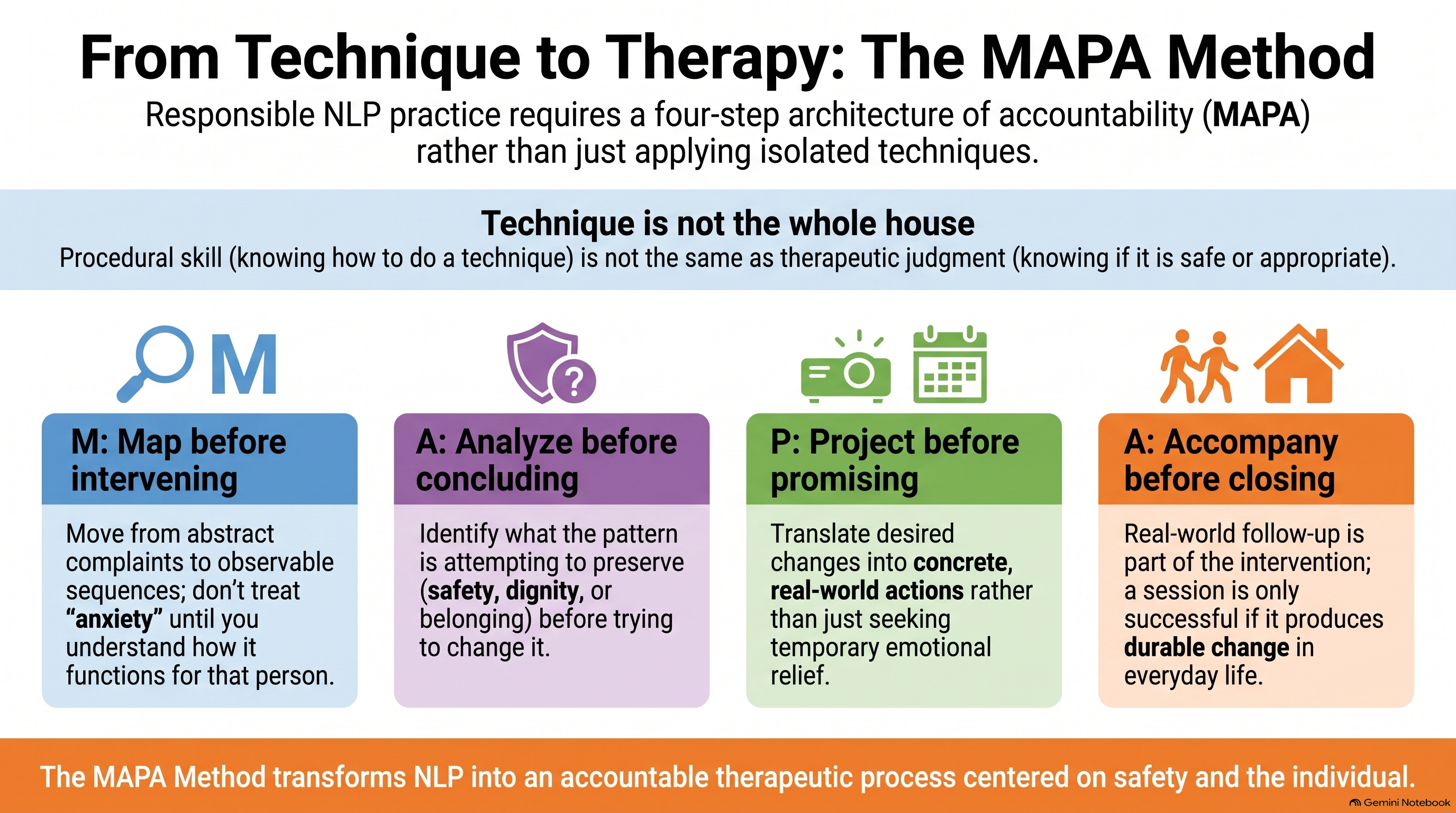
The MAPA Practitioner level serves as a bridge for those with prior NLP training, focusing on the MAPA Method to ensure interventions are used responsibly within structured therapeutic settings.
The MAPA Master level addresses complexity and ambiguity, teaching practitioners how to handle conflicting internal systems and longitudinal case management.
Both programs emphasize ethical boundaries, continuous consent, and the necessity of professional supervision while distinguishing these skills from statutory licenses in regulated fields like medicine. The curriculum requires significant training hours, written assessments, and behavioral evaluations to ensure a high standard of accountable practice. Overall, the sources advocate a shift from the simple application of techniques toward a systemic, reflective approach to therapeutic work.
This framework addresses safety and ethical concerns by embedding traditional Neuro-Linguistic Programming (NLP) techniques within a rigorous, professional, and clinically responsible architecture
Safety Before Depth: The framework establishes safety before depth as a foundational rule for therapeutic maturity, prioritizing a practitioner’s capacity to identify when not to proceed with an intervention. It systematically manages safety and ethics through several core pillars.
Pre-intervention Screening: Before engaging in emotionally intensive work, practitioners must systematically assess critical safety issues, including the risk of suicide or self-harm, active violence or coercive control, impaired contact with reality, substance abuse, and severe sleep deprivation.
Alternative Actions and Referrals: When safety risks are flagged, the framework dictates that the most responsible action is not an NLP technique, but stabilization, safety planning, medical/psychiatric evaluation, or emergency care. The framework explicitly reinforces that "stopping is not abandonment" and "referral is not therapeutic failure".
Continuous Choice: Clients retain the absolute right to pause, refuse, request a different pace, or withdraw their consent at any point during an exercise.
Unlike administrative, one-off consent procedures, the MAPA method treats consent as an ongoing, active, and revisable process.
Transparency: Before any intervention—particularly those involving hypnosis, mental imagery, or emotional intensification—practitioners must thoroughly explain what is proposed, why it is being considered, what discomforts might occur, and what alternatives exist.
Rapport is Not Compliance: The framework cautions that rapport must never be used to gain obedience. A client's hesitation or refusal is not treated as "resistance" to be overcome, but as an active boundary, a communication of insufficient safety, or a correction to an inaccurate formulation.
Dangerous Territories: The framework warns against misapplying the NLP principle "the map is not the territory" to bypass objective external problems, stating clearly that "sometimes the territory is dangerous".
While historical NLP training often focuses heavily on a client's internal representations, this framework insists that internal representation and external reality must be considered together.
Real-World Ecology: Ecological reviews must explicitly evaluate real-world factors such as physical safety, financial dependency, domestic abuse, power imbalances, and discrimination. For example, a practitioner must never push a client to confront an abuser simply because "assertiveness" was identified as a goal.
Ethical Qualification of Techniques: Reframing must never be used to invalidate grief, injustice, or actual danger, and perceptual positions must not be used to demand empathy for an aggressor.
No Statutory License: An INLT certificate does not confer the legal status of a psychologist, therapist, or physician.
The framework does not seek to bypass legal regulations governing professional titles or practice.
Differentiated Scope: Legally authorized clinical professionals may integrate the method into clinical practice. However, non-clinical professionals (such as coaches or educators) must restrict their use of MAPA principles to goal clarification, safety recognition, and referral, and must never represent their work as a treatment for mental disorders.
The framework's training curriculum actively dismantles harmful, oversimplified psychological assumptions that sometimes propagate in technique-centered environments.
It explicitly teaches that:
- Trauma is not merely an unpleasant internal image.
- Grief is not a failure to reframe.
- Violence must not be converted into a compulsory growth opportunity.
- Depression is not simply deficient state management.
- Illness is not evidence of an incorrect belief.
- Anxiety may coexist with genuine, objective danger.
Recognizing that powerful in-session emotional breakthroughs do not necessarily translate into lasting positive outcomes, MAPA makes longitudinal follow-up a central responsibility.
Adverse Effects Monitoring: Practitioners are trained to actively monitor for deterioration, non-response, and adverse events (such as emotional destabilization, increased shame, memory confusion, or dependency).
Supervision: Practitioners are expected to engage in regular clinical supervision to analyze errors, practitioner overconfidence, rescue impulses, and adverse events, ensuring reflective and responsible clinical practice.
Curriculum “MAPA Practitioner in Integrative Neuro-Linguistic Therapeutic Practice, IN”
Curriculum “MAPA Master in Integrative Neuro-Linguistic Therapeutic Practice, IN”
Autor: André Percia
Clinical Psychologist
NLP, Hypnosis and Coaching Master Trainer
His YouTube Channel: www.youtube.com/Andrepercia
YouTube Channel based on NLP and Hypnosis in English:
https://www.youtube.com/@HypnotranceStudio


Mr Francis PETOT
"Hypnosis Master, WHO" training by trainer Mr Francis PETOT in Luxembourg
Read more